SEO Content Brief — the 9-Section AEO Template
The old 6-section content brief won't cut it anymore. Here's the updated 9-section template built for SEO and AEO — structured to rank and get cited by AI.
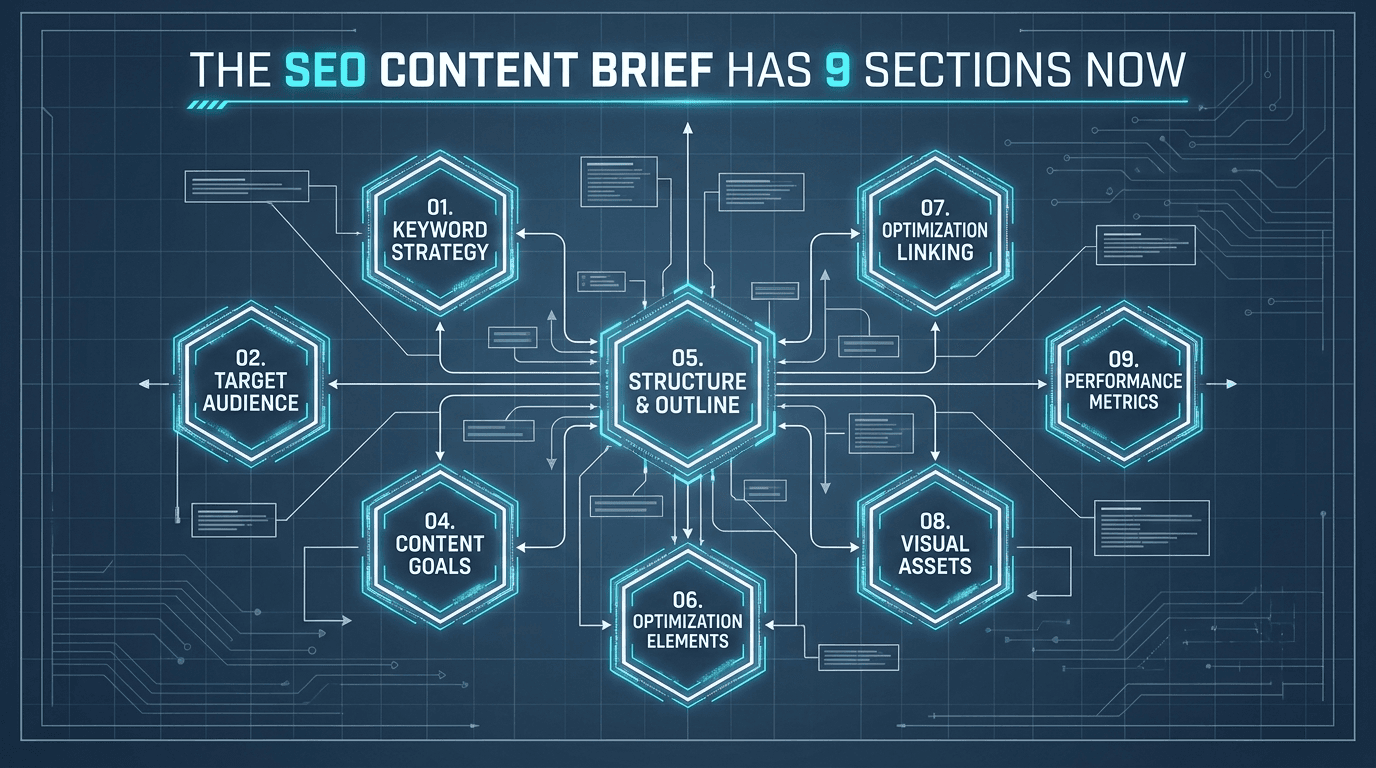
the SEO content brief has 9 sections now — here's what changed
a content brief from 2021 will produce a 2021-era piece of content. that's not a criticism of the people writing them — it's just that the brief is a hypothesis document. it encodes what you believe about how search works at the time you write it.
and a lot has changed about how search works.
the old brief was built to rank in a 10-blue-links world. the new brief needs to rank in a world where Google AI Overviews pull answers directly from your content, where Perplexity cites your pages as sources, and where the person searching might never click through at all — they just need their question answered, and your content either supplies that answer or doesn't.
what the old brief covered (and why it's not enough)
the standard SEO content brief had six sections: primary keyword, secondary keywords, target word count, meta title and description, H2/H3 outline, and internal links. that brief does what it was designed to do. the problem is that traditional SERPs are no longer the only game in town. AEO requires three additional inputs that the old brief simply doesn't address.
the 3 new sections
Section 7 — the answer-first declaration. at the top of every brief, before the outline, write one sentence that answers the primary question in 50 words or fewer. this forces clarity about what the piece is actually for. AI systems extract from pages that answer questions directly and early. if your writer doesn't know the 50-word answer before they start, the content won't contain one.
Section 8 — schema type and FAQ block. specify which schema markup applies and whether a FAQ block is needed. for most blog content: Article schema plus 3–5 FAQ entries pulled directly from People Also Ask for the primary keyword. FAQ schema is one of the clearest structural signals that a page is attempting to answer specific questions.
Section 9 — citation target. which AI engine is this piece primarily positioning for? Perplexity favours direct factual answers with source attribution. ChatGPT search favours structured comprehensive content. Google AI Overviews favour content that matches the exact phrasing of the search query in the first 200 words. pick one primary target based on where your audience is most active.
the full 9-section template
1. Primary keyword — the exact phrase you're targeting. one per brief.
2. Secondary keywords (3–5) — related terms that extend the topic, not repeat it.
3. Search intent — informational / commercial / navigational / transactional. if mixed, state which is primary.
4. Target word count — based on SERP competitor averages. for AEO, the goal is the most complete answer in the fewest words.
5. Meta title and meta description — include primary keyword in both. meta description ends with a soft CTA.
6. H2/H3 outline — headers phrased as questions where possible. questions in headers trigger AEO citation more reliably than statement headers.
7. Answer-first declaration — one sentence (max 50 words) that is the complete answer. the writer pastes this directly into paragraph 1.
8. Schema type + FAQ entries — schema type plus 3–5 FAQ entries pulled verbatim from People Also Ask.
9. Citation target — primary AI engine to optimise for, with notes on that engine's content preferences.
the brief is still a hypothesis
the difference between a brief that produces mediocre content and one that produces something genuinely useful is the answer-first declaration. if you can write that 50-word answer clearly before the brief goes to a writer, the rest of the document is just instructions for expanding it. if you can't write the 50-word answer, the brief isn't ready.
the AEO era rewards clarity. the brief is where clarity either gets built in or gets skipped. most people are still skipping it.